


When asked, “Are you good at English?” most Korean English learners tend to answer, “I can read and listen to some extent, but speaking is really difficult.” Even after studying English for years, the sentences that actually come out often remain just fragmentary combinations of words. The people Real Speaking wants to be with are exactly those who have these concerns.
Starting English speaking again as an adult is not an easy challenge. Unless there is a clear, immediate survival-driven purpose such as a business meeting or living abroad, it is even harder to maintain steady motivation. But the real reason we struggle to start speaking is not a lack of motivation, but that we have not trained the way the brain builds sentences.
Real Speaking does not rely on vague motivation. Instead, through learning design grounded in cognitive science and psychology, it transforms the English lying dormant in your mind into practical speaking skills that bring it out into real speech.
Learning with Real Speaking
If Real Class served as the input channel through which learners acquired English knowledge and learning, Real Speaking is centered on intensively creating output. True to its name, Real Speaking is built around speaking-focused learning features. Let’s take a closer look one by one.
Chaining
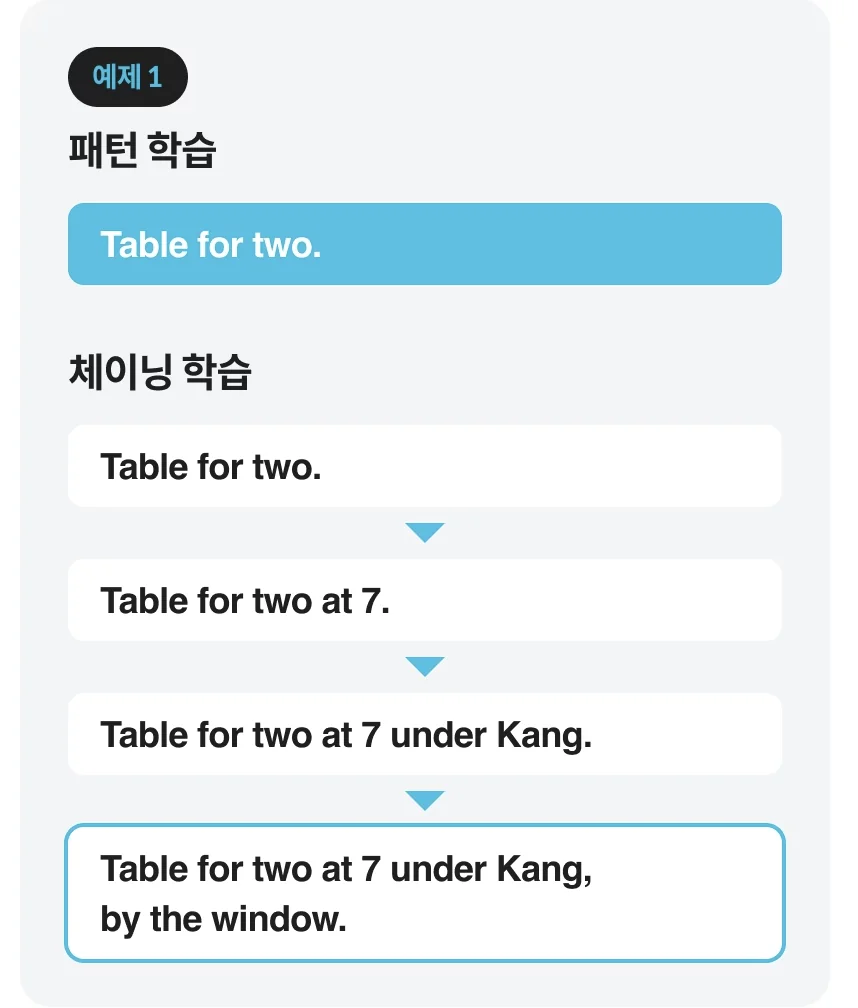
The core learning method of Real Speaking is Chaining. Rather than trying to say a long sentence all at once and giving up, the Chaining method starts with short core patterns and expands the sentence little by little, adding one phrase at a time. It can also be seen as a model that applies the psychological principle of behavioral chaining*(the process of breaking one complex task into small, distinguishable steps and connecting them like links in a chain to form one complete behavior)* to English learning.

Principles of Chaining Learning
The chaining process in Real Speaking is the same as the process by which the brain expands language. Just as the brain creates speech by assembling and stacking the smallest meaningful units in real time when storing sentences, chaining can also be understood as stacking new blocks on top of blocks of meaning.
Chaining Learning in Detail
- STEP 1: Check the pattern: In short video content of 10–15 seconds, learners identify frequently used short core patterns.
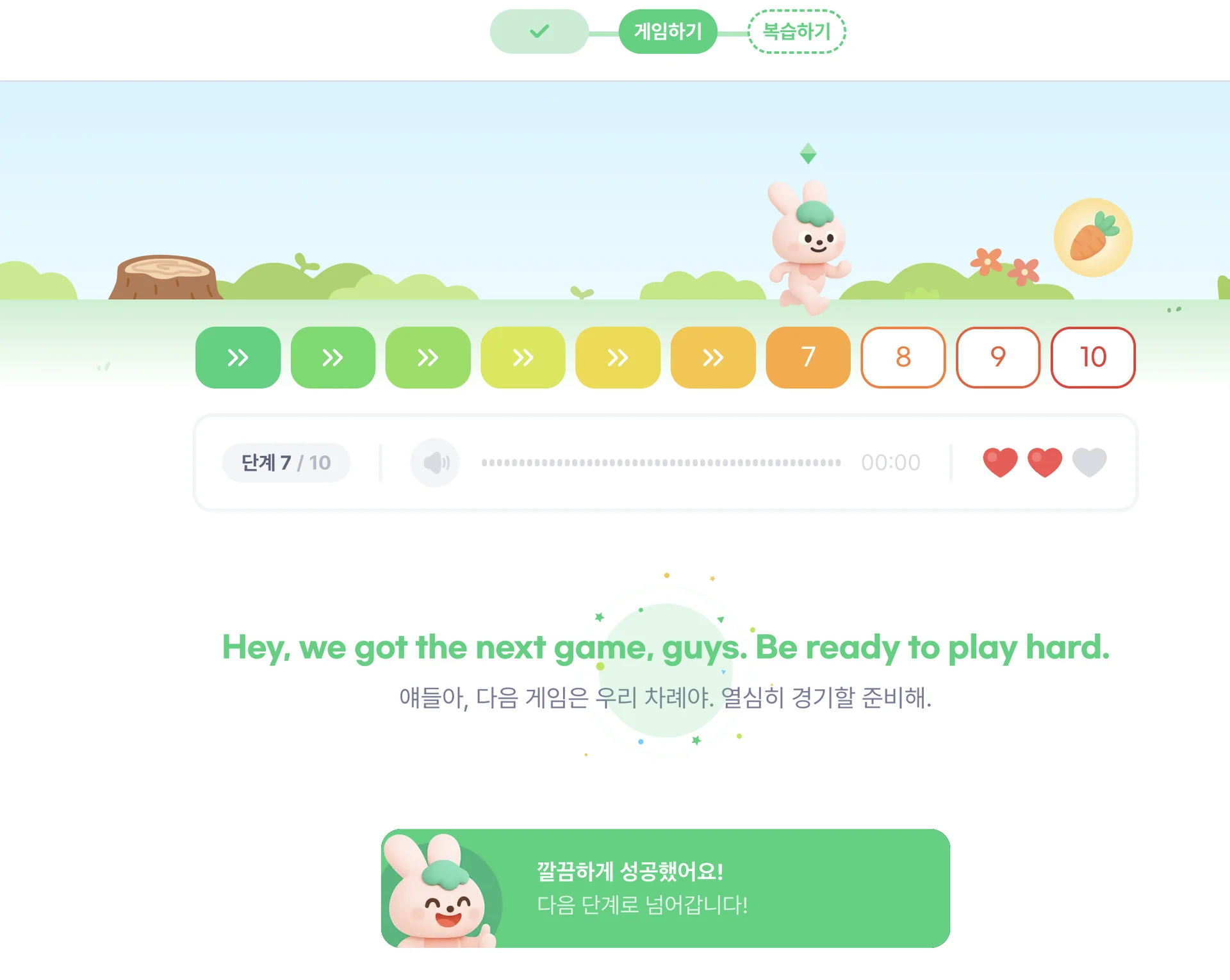
- STEP 2: Chaining: After opening with a short sentence that serves as the framework, learners connect expressions like a chain to gradually lengthen the sentence. A total of 10 stages are completed.
- STEP 3: Review: Learners practice again by revisiting the sentences that were difficult to repeat during the chaining stages.


Effects of Chaining Learning
The greatest effect of chaining learning is that it achieves automation in speaking while minimizing cognitive load. By breaking sentences into the smallest units the brain can process and repeating them, knowledge once understood only in the head becomes embodied as a skill that comes out unconsciously. Through this, learners go beyond simply memorized sentences and gain the ability to freely generate new sentences suited to the situation by using the sentence formats built in the brain.
Conversations
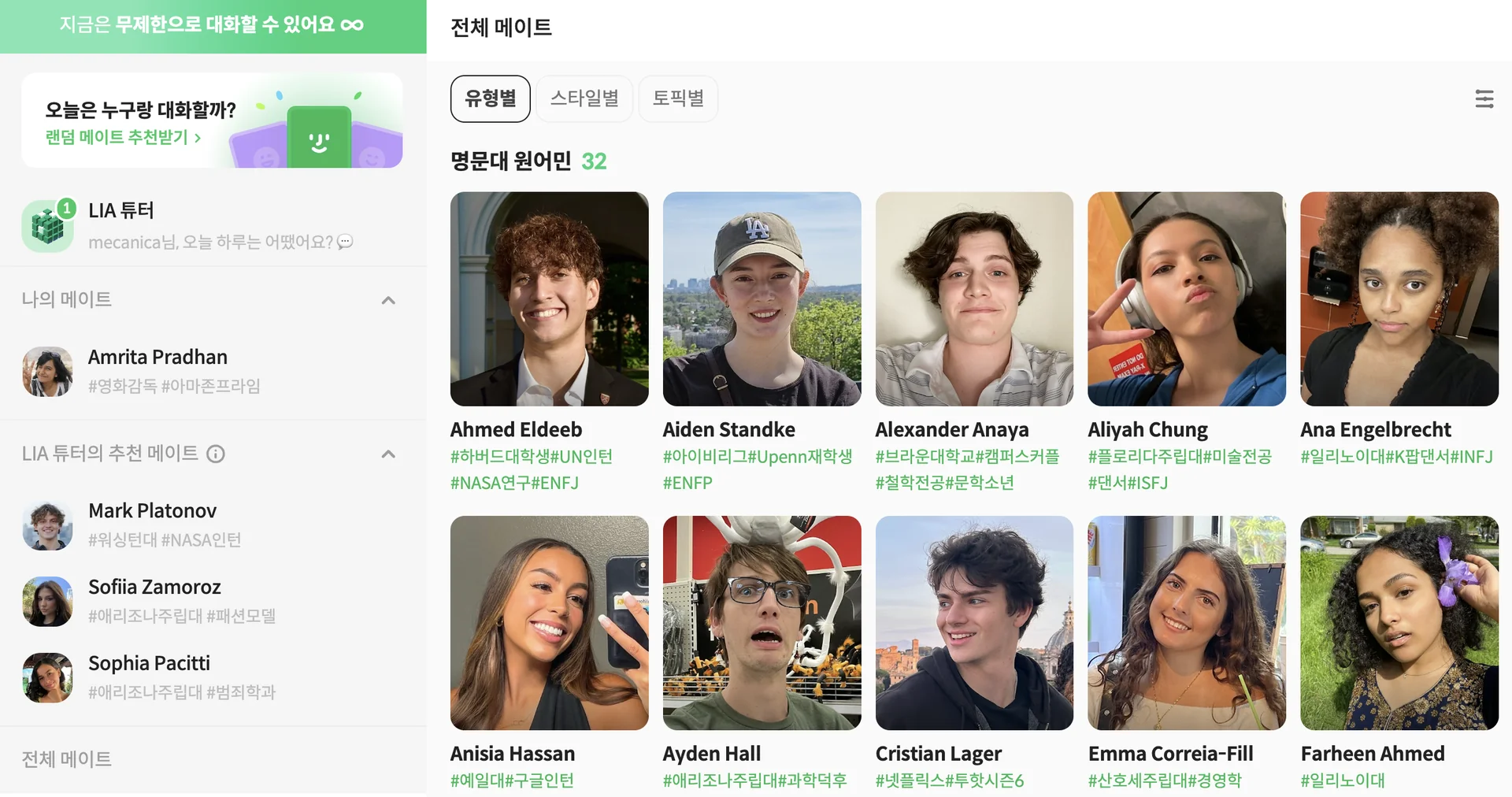
The foundational stamina built through chaining is completed through real conversation practice. Conversations with AI native speakers within the service are not simply exchanges in English, but are like simulations that convert the user’s thought process into English. By talking with around 50 native-speaker AI mates based on the experiences and information of real people, users naturally try out the patterns they have learned or apply them to new situations, building real practical experience.
Principles of Mate Conversations
Mate conversations go through several stages in order to overcome the limitation of learners repeating only the expressions they already know. This process—Mate’s question → user’s Korean utterance → user’s English utterance → Twin’s feedback—follows the exact cognitive route the brain uses to process a foreign language. In particular, the process of thinking first in Korean and then expressing it in English removes vague fear and trains learners to match what they want to express with accurate English data.
Mate Conversations in Detail
- STEP 1: Listening & Korean utterance: Learners listen to the AI Mate’s question and comfortably say what they want to say in Korean. In this process, the spoken content is visualized as text.
- STEP 2: English retrieval: Based on the visualized Korean content, learners speak English at the level they know. This is an active learning stage that retrieves declarative memory from the brain.
- STEP 3: AI Twin feedback: An AI Twin synthesized from the user’s appearance and voice appears and reconstructs what the user wanted to say into the most complete native-like English, then plays it back. In particular, this feedback is not simple correction; it proposes English sentences at a level slightly above the user’s current level, which is even more helpful for improving English skills.


Effects of Mate Conversations
The greatest effects of mate conversations are lowering psychological barriers through self-modeling and maximizing practical application skills. When learners visually and audibly experience a Twin that resembles them speaking fluently, the brain accepts it as a powerful reward, increasing learning motivation. In addition, by transforming the sentence formats built through chaining into their own stories within real conversations, users develop conversational ability that helps them open up speaking in various situations.
The process of learning a language should be an experience of discovering your changing self. Real Speaking’s learning journey also strengthens the foundation by adding technology to the way the brain acquires language: pattern learning that builds a solid base, chaining that adds layer by layer by level, and conversations with mates that feel like real-life practice—taking care of what users need and filling in what they lack, so they can reach the level of their own English role model as fluent English speakers.
Real Speaking is not the single perfect answer that solves every challenge in English learning. But it aims to be the most reliable tool for getting learners to start speaking with the lowest possible psychological barrier. So that learners’ hesitation can lead to confident action, the Real Speaking team will continue to embody solutions to every problem users face through a highly advanced product experience.