
Hello, I’m Jang Jusang, a brand designer in Riiid’s Global Brand Chapter.
At Riiid, a technology-driven AIed company, we create a variety of learning products. By developing diverse products in the market centered on AI-based diagnostics and learning technology, we aim to experiment with new technologies and ideas and pioneer new markets. ‘Santa SAY,’ which I’d like to talk about today, is a family brand of Santa and an AI mock test service where users can practice speaking in an environment identical to the actual TOEIC Speaking language exam and receive score predictions and feedback. AI models such as STT*, score prediction, and grammar correction are used to help users achieve their target scores in a short time and at low cost.
*An abbreviation for Speech-to-Text, referring to technology that converts speech into text.
Before starting the project, we set three goals for SAY’s brand identity. In the process of creating a family brand within a technology company that builds multiple products, I’d like to share the concerns I felt and the process of achieving the three goals below.
1. Be recognized as a family brand with Santa
2. Discover an independent motif representing a conversation-based learning service
3. Build a service identity differentiated from competing services
“A new conversation-based product is coming out…!”
**Brand Structure
**When a new product is launched, the brand team in an organization with various product brands first considers the ‘brand hierarchy’ for brand positioning. Through defining the relationships among existing brands, they need to clearly define the efficiency of brand management and the roles and responsibilities of each brand.
Santa SAY is a product for TOEIC Speaking test preparation, and among Riiid’s various products, it naturally became associated with Santa, the TOEIC test prep service. To specifically define the brand relationship and hierarchy of the new product, it was necessary to understand the characteristics of both the TOEIC and TOEIC Speaking exams.
_“Do TOEIC prep users who use Santa switch to TOEIC Speaking, or is there continuity between the two exams?”
“No. The names are similar, but the evaluation areas, test duration, test fees, exam cycles, score ranges, and main assessment areas are all different.”_
**They’re too different: TOEIC and TOEIC Speaking
**To start with the conclusion, because TOEIC and TOEIC Speaking products serve different customer needs, their brand positioning also had to be different.
TOEIC and TOEIC Speaking are both representative exams that assess English proficiency. ‘TOEIC’ and ‘TOEIC Speaking’ may seem similar, but the characteristics of the exams and the preparation process are very different, with virtually no overlap. In terms of assessment areas, TOEIC focuses on ‘listening and reading’ and evaluates overall English ability, whereas TOEIC Speaking focuses intensively on ‘speaking ability.’
The customer need in the English test prep market is ‘efficiency.’ It is important to help users achieve their target scores by efficiently designing factors such as the time required to reach the score, the financial cost needed for test preparation, and selecting lectures suited to their learning level. Choosing which exam to prepare for is also done efficiently.
Depending on the purpose requiring a score—such as employment, graduate school admission, studying abroad, immigration, or overseas employment—learners independently choose and study for just one of several English tests. Because of this independence, users preparing for the TOEIC do not switch to TOEIC Speaking, nor do they prepare for both TOEIC and TOEIC Speaking at the same time. Since the time and financial opportunity costs wasted in preparing for both are enormous, customers tend to study for only one of the two exams.
**Independent, but connected
**As such, because the customers of the two services did not overlap and the existing brand ‘Santa’ could not fully encompass the TOEIC Speaking domain, after reflecting the opinions of various stakeholders, it was decided that it should be recognized as a brand with independence. However, since both services are still products for exams administered by ETS (Educational Testing Service) in the U.S., both include the word TOEIC, and there was a marketing strategy to improve efficiency by leveraging Santa’s brand recognition, we set a brand design goal that it should be recognized as a brand that is independent, yet connected.
**[Goal 1] Be recognized as a family brand with Santa
**After understanding that both names include ‘TOEIC’ but represent independent test markets and customer learning journeys, we began discussing several brand structures within the brand team.
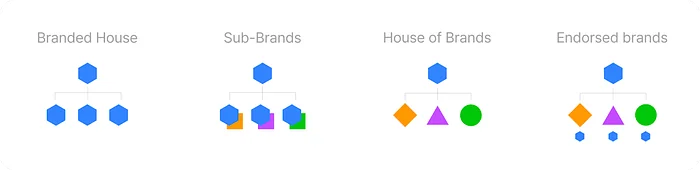
We applied each of the four brand hierarchies above one by one to find the most suitable structure. First, in the case of the ‘Branded House’ structure, where a domain is added to the existing brand, customers preparing for TOEIC Speaking might see the Santa SAY brand and perceive it as ‘TOEIC,’ leading to identity confusion, and the independence of the new brand would be weak, so this structure was excluded. The third option, House of Brands, where multiple brands each have their own personality, and the fourth option, Endorsed Brands, were also excluded because their connection to Santa would be weak, making it difficult to establish recognition as an English learning product and creating marketing challenges. In the end, we defined the brand hierarchy as a ‘Sub Brands’ structure, where the TOEIC Speaking prep service exists within the ‘Santa’ brand but maintains independence.
**A fast-moving brand development process
**In the end, building SAY’s brand identity took a relatively short amount of time. I believe many technology-driven organizations struggle to align product development and brand design timelines. Because of tight schedules, this can result in incomplete quality, insufficient reflection of the product team’s opinions, or outcomes that are difficult to expand in the future.
To solve this, and to quickly capture the opinions of the current product-making organization while flexibly responding to the future direction of the brand, we applied the MVB (Minimum Viable Brand) process as a way to build a brand identity with the most basic structure. Although it is not a widely used concept, MVB is similar to MVP (Minimum Viable Product). It is a brand design approach in which a minimal brand identity for a product or service is built and launched to the market, and then the product or brand image is improved and expanded based on insights such as stakeholder and customer reactions and preferences.
Get Jang Jusang’s stories in your inbox
**Step 1: Stakeholder Brand In-depth Interview **As the start of the MVB process, a Brand In-depth Interview document is created and delivered so product stakeholders can respond quickly.
Q. What benefits do customers expect from the product?
Q. Who do you think is the core target of this product?
Q. What do you imagine this product will look like in 5 years?
Some of the In-depth Interview questions
**Step 2: Define the brand mission **Afterward, in the detailed process, the brand designer and brand strategist break down each interview response sentence by sentence and group them together. They also review what the product needs to do, namely the strategy and customer feedback gathered through PoC. Ultimately, what the product fundamentally solves is translated into customer language to define customer value—that is, the brand mission.
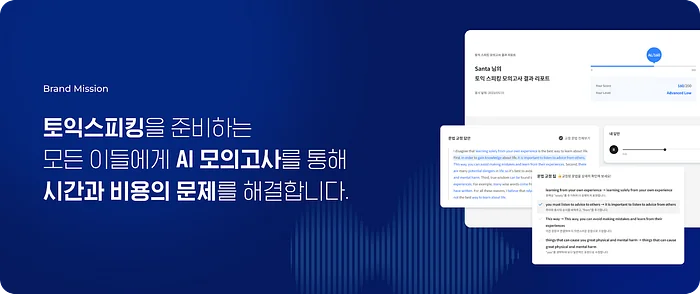
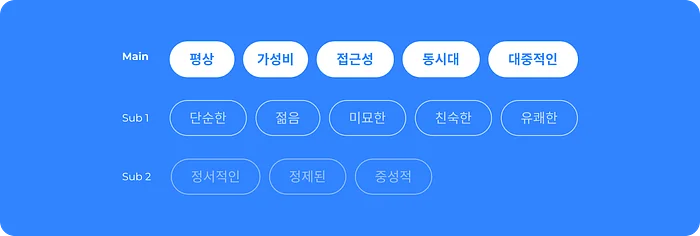
**Step 3: Capture the brand impression **In addition, to capture the brand impression envisioned by the product makers, we conducted a Brand Personality Slider. By listing the priority of keyword results, we established a foundation that the whole team could agree on. What is important when running a Personality Slider is to present specific brand examples so that stakeholders can visualize and conceptualize unfamiliar and ambiguous brand keywords, allowing them to share the same impression.

By presenting keywords that can be agreed upon, we captured the brand impressions that each stakeholder perceived either completely differently or similarly, and derived the brand keywords that drew the broadest agreement. Through this, we captured the brand image envisioned by the product team with minimal documentation, enabling the rapid development of a brand identity that could be executed and function quickly.
**Step 4: Brand Naming
**We carried out brand naming ideation. When developing project-based products, such as when IT companies run hackathons, we often see cases where the initial project name is used 그대로 as the brand name. As teams set a ‘project name’ and develop the initial idea, they naturally become attached to that name. But when it comes time to finally expose the brand to customers, the brand team, which must consider many perceptual factors, finds itself facing a deeper dilemma.
**There may be no right answer, but there is one
**The biggest challenge in selecting a product name is that it seems like ‘there is no right answer.’ Because of that, from the brand team’s perspective, which reviews and changes names, conflicts can sometimes arise with the product team. Brand naming may seem to have no correct answer, but a good name helps product recognition, and naming rules that fit the overall family can create connections to the parent brand and give a more dimensional impression. That is why the brand team works to let various organizations know that naming rules unique to the organization and product names also need to be designed, while increasing understanding of this point. (Go, GBC team!!)
While sharing the brand naming perspective above, we conducted brand naming ideation together with the design organization, including product stakeholders. Santa SAY’s initial project name was ‘Santa Sprite.’ It was a portmanteau of speaking and writing. While Sprite was also a good name, the main opinion was that it was difficult to intuitively associate it with the TOEIC Speaking test, which proceeds as ‘conversation, that is, spoken language.’ There are various ways to determine a brand name, but to reduce confusion and increase the density of discussion through the MVB method, we provided a naming ideation frame.
“Oh, I didn’t know there was a method like this! Having this kind of frame makes it feel easier to throw out ideas rather than squeezing them out from zero. It was such an interesting experience.”
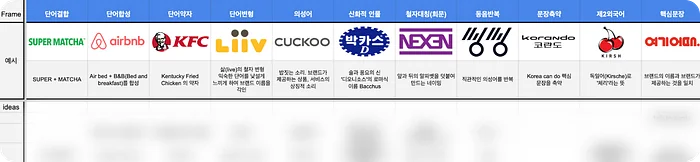
In a short amount of time, the product team and brand team together proposed a total of 46 naming candidates, and ultimately selected 3. 1st place: Santa SAY, 2nd place: Hi Santa, 3rd place: Santa R.eech. Among these three, SAY was selected as the top candidate because it is both an abbreviation of ‘Speaking Ai for You’ and a verb meaning to speak, making it easy to intuitively recognize it as a conversation service.
In this way, through the MVB process, we derive the materials needed to concretize brand design, such as the brand mission, impressions, and naming. Through the MVB process, we quickly and efficiently listened to the opinions of many stakeholders and involved them in the brand-building process, laying the groundwork for creating an identity aligned with the product.
Recently, what customers expect from brands has become more diverse, and the focus is on building relationships and empathy with customers. In response to these changing customer expectations, we continue evolving the brand, including securing greater diversity for it. Internally as well, in order to solve the immediate problems in the brand creation process for an organization that changes and adapts quickly, we believe that sometimes taking experimental challenges is also part of Riiid’s way of eliminating the three ‘i’s in the education market: inefficiency, inconsistency, and inequality.
“It was fun just participating in the brand creation process! It doesn’t just pop out instantly when you make a request — I realized these are the kinds of elements you consider, which helped me understand the brand team better, so I liked it even more!”
While designing the SAY brand, we also heard the question of whether it might be better to focus on improving the completeness of the final output rather than spending time listening to the opinions of the product team and stakeholders. In response, we believe that in today’s AI era, the capabilities brand designers need even more are open ears and an open mind, along with a receptive attitude toward creating together.
In the next article, we would like to talk about the process of deriving the final outcome through the materials used to concretize brand design (brand mission and impression, naming).
If you want to learn more about Santa SAY,
→ Go take a look at Santa SAY